
The Ideal Number of People for a Pool Night, Ranked (Two Is a Date, Eleven Is a Mistake)
The right number isn't the biggest number. It's the one where nobody's holding coats.
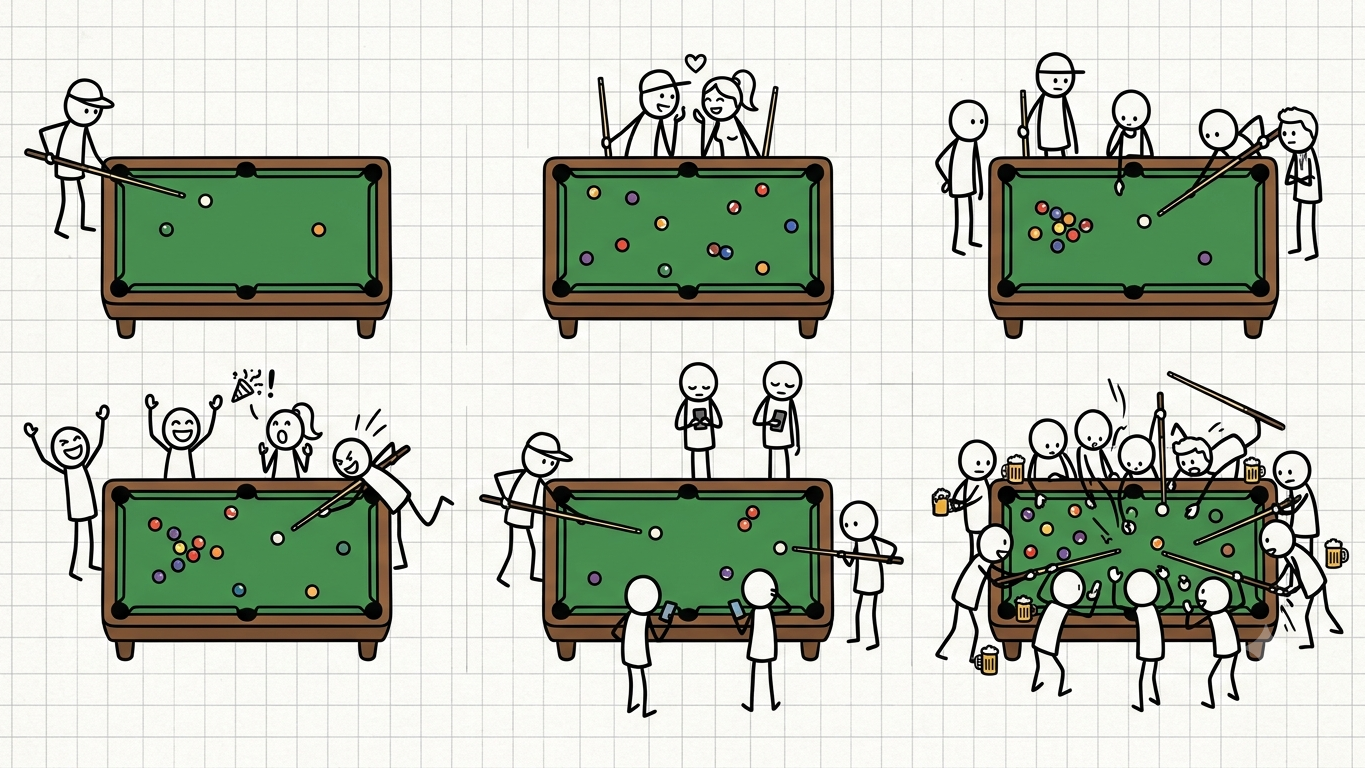
You are not planning a pool night. You are planning for a number. The headcount gets settled somewhere in the group chat, days before anyone chalks a cue, and that number quietly decides what kind of evening you are actually about to have. Two is a date. Four is the sweet spot nobody argues with. Six is a good time wearing a logistics problem. Eleven is a mistake, and we will get to why. Choose the number wrong and no amount of good pool rescues the night. Choose it right and you barely have to try.
Two: the date, or the two who actually wanted to talk
Two people is the best conversation-to-pool ratio there is. The table stops being the point and becomes a prop, something to do with your hands while the real event, talking, happens around it. This is a date, or it's two friends who picked each other on purpose and wanted a couple of hours to catch up without putting every decision to a group vote. It almost never goes wrong. The one failure mode is mild: if both of you are secretly trying to win, the catch-up curdles into a match nobody agreed to enter. Otherwise two is warm, easy, and completely undemanding. Keep it.
Three: the awkward one
Three is the problem child. Winner stays on, technically, which sounds democratic right up until you notice that someone is always the one sitting down, and by some iron law it is always the same someone. They drift toward the wall. They find their phone. Now you have a two-player game with a live studio audience of one, who is smiling politely and quietly working out how early they can leave. Three can work, but it needs managing: rotate on purpose, lose on purpose if you have to, and never let the odd one out stay odd for more than a rack. Handle with care. Three is the number most likely to manufacture a person pretending to have fun.
Four: the sweet spot, no notes
Four is correct. This is the platonic ideal of a pool night and the number this whole piece is secretly arguing for. Doubles picks itself, the rotation is natural, nobody waits more than a couple of minutes for their next shot, and everyone stays in the game the entire time. Nobody is holding coats. Nobody has quietly gone to their phone. There is nothing to fix. If you could only ever choose the size of your group blind, before you knew who or where or when, you would choose four every single time and you would be right to. Four is where the whole case for pool as the best group activity is at its most obvious and least deniable.
Five to six: a good time wearing a logistics problem
Now it becomes work. Five or six on a single table means a queue, and the queue is where the phone-scrollers are born, because a person who waits fifteen minutes for one shot will find something to do with the other fourteen. One table and six people is not a pool night. It's a waiting room with a felt centrepiece. The fix is neither clever nor optional: get the second table. From five up, two tables should be the default, and suddenly six is wonderful again, two loose games with people drifting between them, everyone playing at once. If you are genuinely stuck on one table, this is the exact situation the games that aren't 8-ball were invented for. Killer and cutthroat keep six people inside one game instead of leaving four of them to stand around and spectate.
Seven and up, where eleven is a mistake
Past six, something shifts, and not in your favour. It stops being a pool night and becomes a gathering that happens to have a table in the room. The pool is now the backdrop. Somebody is holding three coats and a tote bag they never agreed to guard. Somebody has brought a plus-one nobody has met, who is perfectly nice and completely unplaceable. And then there's eleven. Eleven is not a pool night, it's a birthday, and it deserves to be planned like one. No, you cannot all play a single game of 8-ball. No, you will not "just take turns," because eleven people do not take turns, they form factions. One faction wants to keep playing, one faction has discovered the food menu, and a third has quietly relocated to a booth and is no longer part of the evening in any meaningful sense. If your group has cleared double figures, accept what you are, book properly, and stop pretending the table is the main event. You are catering now.
The one rule, and the only number that matters
Here is the single piece of admin worth the breath: past four, you book. A walk-in is fine for two, charming even. Nine people negotiating in a doorway over whether there's space is not a plan, it's a hostage situation with cues. Book the table before you become the group that ruined its own night in the lobby.
And the number itself? The right one was never the biggest one. The biggest number feels like generosity in the group chat and turns into coat-holding by ten o'clock. The right number is smaller, quieter, and better. It's the one where everyone is playing, nobody is waiting, and there is not a single person over by the wall holding four jackets, wondering why they came.