
How to Beat a Better Player at Pool (Without Actually Getting Better)
A five-tier system for the player who is currently losing. Mostly legal. Mostly.
You're at the pool hall, it's 3-0, and the better player is being polite about it, which is somehow worse than if they were gloating. They keep asking if you want to switch sides. They keep saying "ah, unlucky." The next frame is about to start. You can already see how it goes.
Practising is a six-week project. You don't have six weeks. You have the next break.
There is a system. It works. It is, depending on your interpretation, marginally unethical. We're going to walk through it.
Tier 1: Choose the Battlefield
The format you accept is half the fight. Long 8-ball frames, best-of-five, alternating breaks decided by whoever wins the lag: that's a tournament structure dressed up as a casual evening. You're not going to win a tournament against the better player. Don't enter one.
Switch to 9-ball, where one lucky pot wins. Switch to first-to-three. Introduce a handicap before they've noticed you're proposing a handicap. If your group is up for it, swap to a challenges format entirely. We covered the menu over here: Fun Pool Challenges to Play With Friends.
The break: insist on alternating. The break is more variance than skill in casual pool, and variance is your best friend in this room.
Verdict: pick the game where luck does most of the work. Refuse to play the game where it doesn't.
Tier 2: Play Smarter, Not Harder
The shot that would impress you is not the shot that wins. Take the boring pot. Run the table backwards from the easiest ball, not the most cinematic one. The bank shot you've been picturing in your head for the last three turns is a fantasy, and fantasies do not pot balls.
Safety play, but call it "being annoying." Leave the cue ball where they don't want it. Snookers count. A four-foul exchange that ends with them gifting you two points is, technically, you scoring two points. The scoreboard does not ask how the points arrived.
If you also want to look like you meant it, we covered that separately: How to Impress at Pool (Even When You Have No Idea What You're Doing).
Verdict: ugly wins are still wins.
Tier 3: Sledging (the dark arts)
Sledging is the cricketer's art transposed to the green baize. Done properly: gentle, plausibly-deniable, designed to land in the half-second before they pull the trigger, never after. Said warmly. Always warmly.
The lines, since you asked. "Tricky cut, that one." "Are you going off the top cushion or just the corner?" "Oh, interesting choice." "Bit much side on that one?" These are not insults. They are not even criticism. They are observations. They cannot be disputed. You have only said what you saw. The fact that you saw it eight seconds before they were going to take a confident shot is your own private business.
The micro-tells layer underneath: silence after their good shots, mild compliments after their bad ones, never react to your own flukes. Take the energy out of their good frames. Energy is currency. Refuse to spend.
The cardinal rule, the only one that actually matters: sledge before the shot, not after. Sledging after is gloating. Gloating loses the room.
Verdict: confidence is doing half the work for them. Take it back.
Tier 4: Conspiratorial Friends
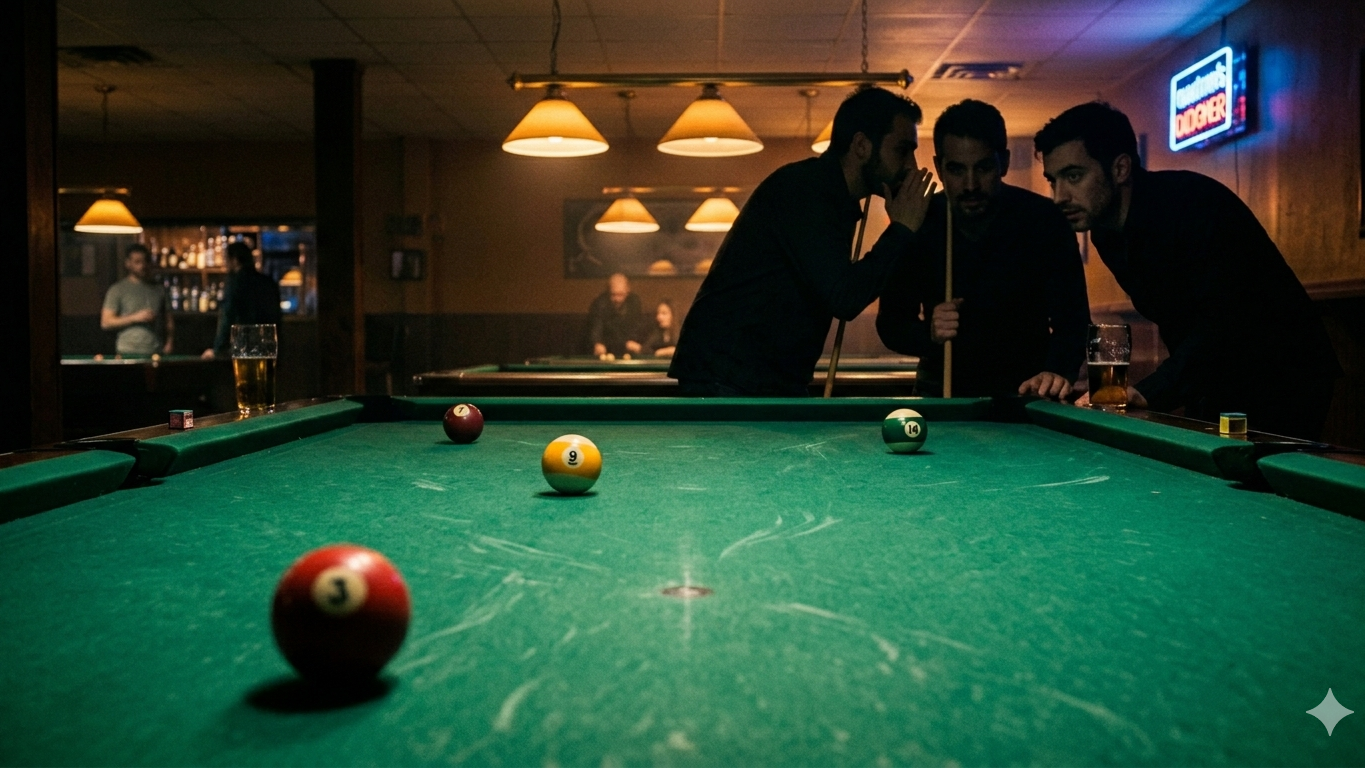
The lone sledger is a heckler. A coordinated group of friends gently echoing each other's micro-doubts is a climate. The opponent cannot disprove a climate.
This requires a team. Brief them. Give them roles. One person notices their grip is "different from earlier." Another quietly agrees. A third asks if they've eaten. Constructive critique disguised as concern: "You're rushing it tonight." "Bit higher on the cue maybe?" "I think you're aiming for the wrong pocket but you do you."
Group reactions are weapons. Nobody flinches at a flat shot. Everyone winces, in unison, at their next set-up. A synchronised inhale at the moment of contact does work that no sentence can.
Snide remarks, never directed, always overheard: "He's playing like the white owes him money." "She's gone full Mosconi." Said to your friend. Loud enough.
The whole room feels the same things at the same time. The opponent feels them too. They start shooting for the climate, not the table.
Verdict: pool is a group event. Use the group.
Tier 5: When All Else Fails, the Nuclear Option
The move: flick the cue ball off the table in their general direction during your shot. Plausibly a misjudged break. Ideally rolls under a different table entirely. Frame momentum, gone. Drinks, re-ordered. By the time the ball is recovered, the rhythm is dead, the mood has reset, and you have, effectively, a re-rack.
Mandatory: blame yourself, loudly and theatrically. The whole gambit only works if you look more embarrassed than annoyed. Apologise to the room. Apologise to the cue ball.
Verdict: not really a tactic. More a kill switch.
When This Backfires
Sledging only works on the tilt-able. Genuinely calm casual players, the ones who hum to themselves during their shot, will absorb it and play better out of mild offence. Read the room before you commit.
Conspiratorial friends only works if your opponent likes them. If they're already feeling outnumbered or excluded, the climate flips from "fun banter" to "you are all bullies" in one shot, and the night is over.
The cue-ball-off-the-table move has a non-zero chance of hitting your opponent, another table, or an open drink. The fallout from any of these scenarios will permanently exceed the value of the frame you were trying to steal. File under "in theory."
This is for casual play, with friends who can take it, in a room with the right vibe. Trying any of it on a hustler, a stranger, a date you actually like, or anyone in a competitive league is your problem entirely.
The Real Ruling
You will not always win. You will win more than you think. The opponent who beats you 7-0 with three of your friends actively psychologically operating against them was never going to be beaten anyway.
The point isn't the trophy. The point is that the frame becomes a group event, and group events are what pool is for.