
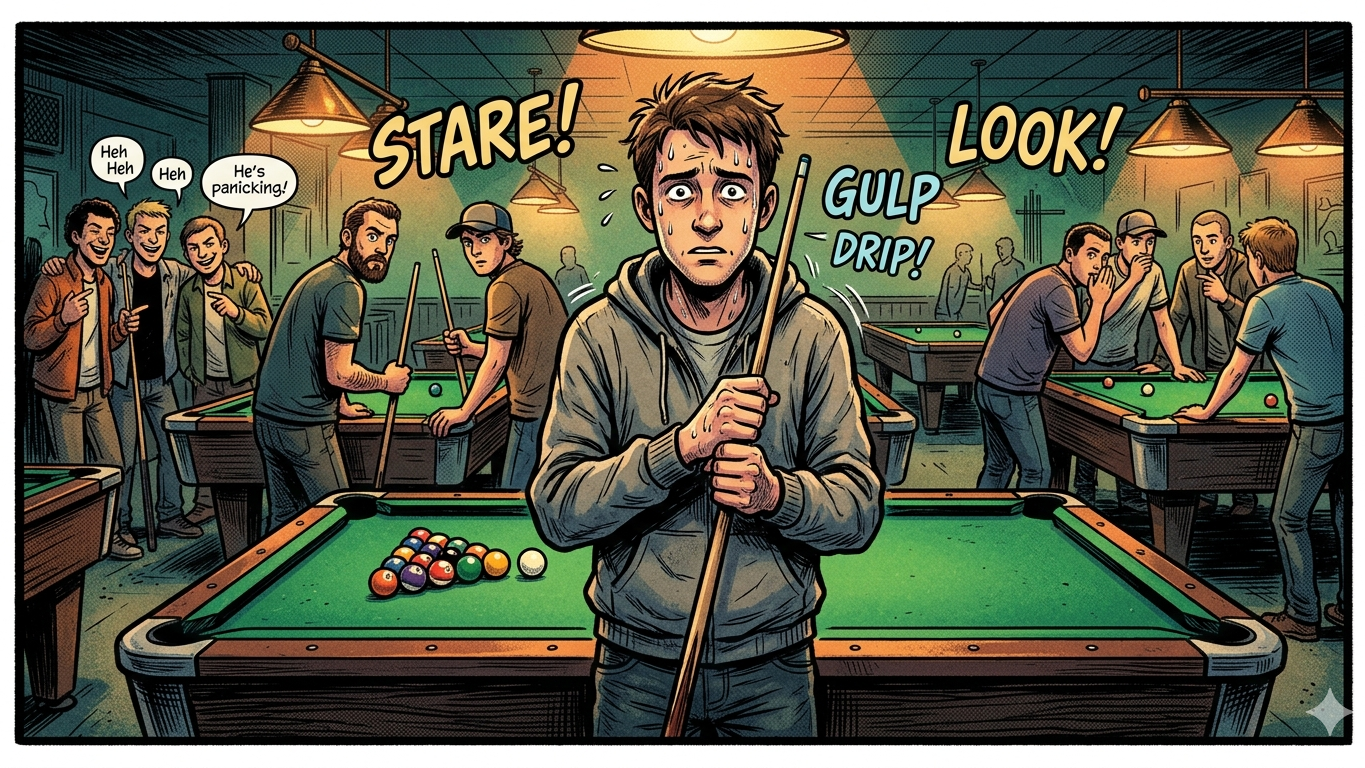
Pool for People Who Think They'll Be Bad at It
You're going to miss some shots. Everyone does. Here's why that's fine, why nobody is watching, and the three things that actually get you to competent within one session.
The feeling is very specific. Someone has put a cue in your hand. It's longer than expected, heavier than you imagined, and there's a moment — usually around the time you try to figure out where to put your fingers — where you're already planning what to say when you inevitably miss everything.
Here's the thing: you are going to miss some things. Probably a lot of things. And it's going to be completely fine.
The Bar You Think You Need to Clear
There's an imaginary version of "being good at pool" that most non-players carry around. It involves some combination of: sinking the ball you're aiming at on most attempts, not fouling too often, knowing the rules without asking, and not visibly wincing when you misjudge a shot. That bar is lower than you think. The stakes for missing it are basically nonexistent.
Myth 1: Everyone Else There Is Good
They're not. Go to any pool hall on a Friday night and do an honest count of the balls actually being potted versus the balls rolling toward absolutely nothing. The ratio is not impressive.
Most casual players — the kind who book a table for a group outing — operate at somewhere between "enthusiastic beginner" and "occasionally competent." The people who look like they know what they're doing have usually just been playing long enough to look relaxed about it. Looking relaxed is most of the skill.
Myth 2: People Will Be Watching You
Nobody is watching you. This is worth repeating. Everyone at a pool hall is focused on three things: their own shot, whether there's a spare chalk cube nearby, and what they're drinking next. A stranger missing a ball at a nearby table registers as background noise. You could miscue dramatically, send the cue ball into a slow spiral of shame across the felt — and the people at the next table would glance over for one second before returning to their game.
This is actually quite liberating, once you sit with it.
Myth 3: There's a Right Way to Stand
Sort of. There are principles — bridge hand, dominant eye, elbow mechanics — that matter if you're trying to become genuinely good. For a casual social game, the only real requirement is: stable, comfortable, not so hunched that you miscue. Beyond that, you'll develop your own slightly wrong stance that works reasonably well.
Half the people in any casual pool game are standing in a way no coach would endorse. They're still having a good time.
The Three Things That Actually Help
If you want to get to "fine" within one session — not good, just competent enough to stop panicking — these are the only three things that matter.
Look at the ball you're aiming at, not the cue ball. The cue ball will go where you send it. You need to watch where it's going to land.
Take the shot slower than feels natural. Every first-timer swings too hard. Slower and deliberate gets more balls in pockets. Counterintuitive and true.
Chalk your cue before each shot. Just a touch on the tip — it stops miscues. It's free and it's on the rail. (Not sure what the chalk situation actually looks like when you arrive? There's a full first-timer breakdown here.)
That's it. No technique, no lessons, no special equipment. Those three things and you'll be fine.
Permission to Miss
Nobody gives beginners this explicitly, so here it is: you are allowed to miss. Out loud. Often. Missing a shot, laughing about it, and watching your friend then miss an easier shot — that's the game. Pool at a casual level is a game you play because it gives you something to do with your hands while you're catching up with people, and because it generates small moments of triumph and catastrophe that are proportionate and immediately resolved.
The worst outcome is you have a drink and a laugh and go home. That's actually a very good outcome.
You'll Be Fine
The version of pool in your head — where your inadequacy is exposed, where you hold everyone up, where you somehow ruin the evening — that game doesn't exist. The one you're actually going to play is informal, forgiving, and mostly an excuse to stand around with people you like.
The hardest part is deciding to go. You've done harder things.