
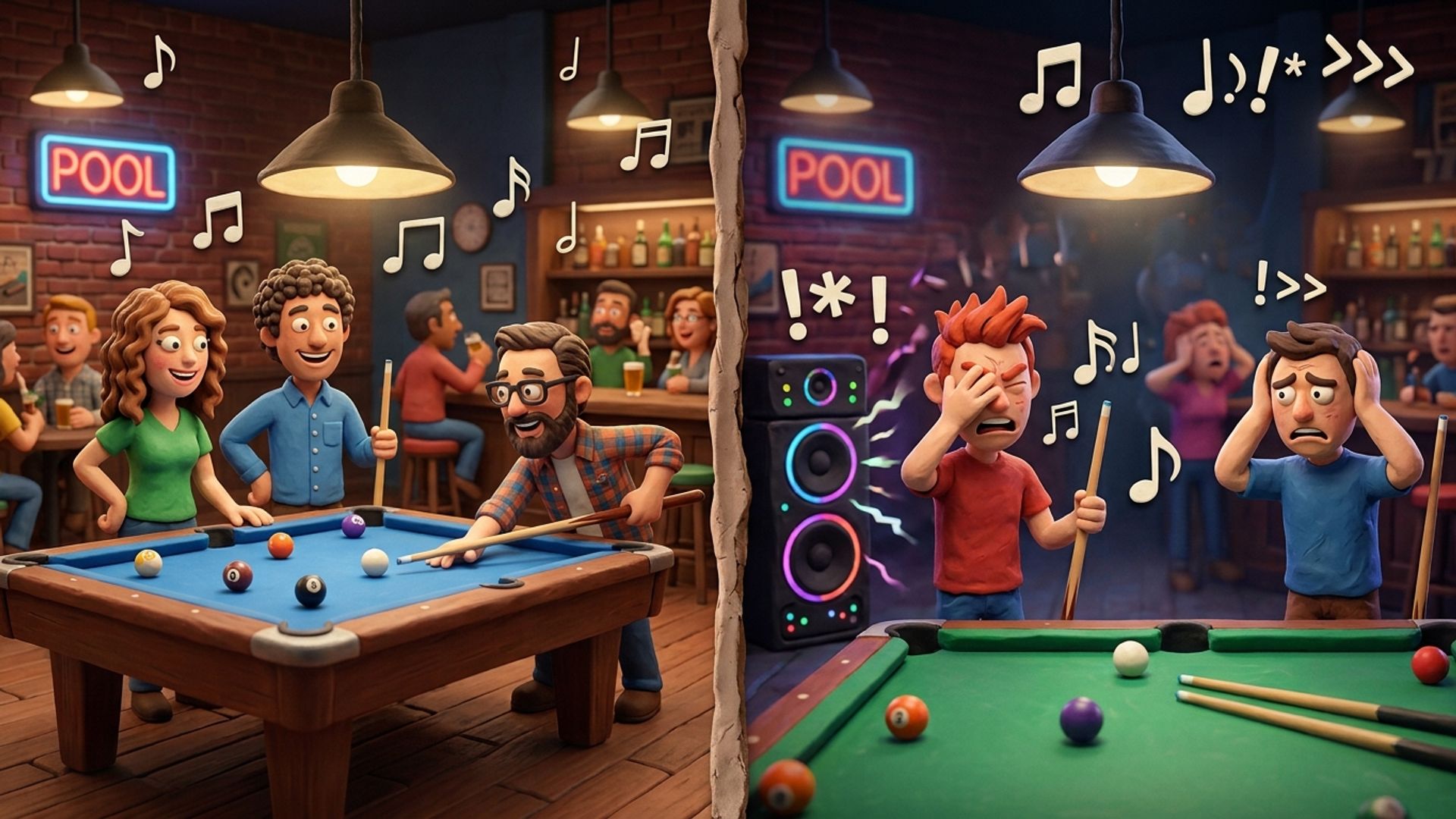
Pool Hall Music, Ranked by What It Does to Your Game
Nobody chose what's playing. It has been running your evening anyway.
Something has been playing for the last hour. You did not choose it, nobody asked you, and it has been quietly making decisions on your behalf the entire time, decisions you would not have signed off on if anyone had asked.
The room's tempo sets your shot tempo, and your shot tempo is most of your game.
The tempo ruling
Here it is, stated as established fact with no evidence offered: fast music makes you shoot fast, and shooting fast makes you worse.
The corollary is the more interesting half. Slow music does not make you better. It makes you deliberate, and deliberating is how a four-minute rack becomes eleven minutes while somebody starts checking their phone under the table. The target is a range, not a genre: fast enough that nobody notices a silence, slow enough that nobody feels rushed. This is the third entry in a set the blog has been quietly building without saying so, after what's in your hand and what's on the table.
The ranking
Six rooms, worst to best, judged entirely on what they do to a table, never on taste.
Near-silence, for a casual night, is bottom of the list and it is not close. Every miss becomes a solo performance, and the group drops into the specific whisper people reserve for waiting rooms. It is also, as we will get to, rarely an accident.
Sport on the TV with the sound up is a different venue wearing this one's clothes. There is now a second thing in the room to look at, and pool is losing to it, quietly, one glance at a time.
The generic upbeat playlist that could be a gym is inoffensive, forgettable, and slightly too motivational for an activity nobody is training for. It does no harm. It does nothing. It is furniture.
Genuinely too loud forces the whole group to lean in just to speak, which is either intimacy or a hearing test, and which one it is depends entirely on how much you like the group you came with.
The one album, played end to end, by a venue that has committed to something, ranks higher than it has any right to. A venue with an opinion is a venue that has thought about the room. You will not like the album. Rank it high anyway, and say so out loud if anyone asks.
Top spot goes to the playlist that is obviously one staff member's, running unattended since about nine. Slightly too personal, occasionally strange, and the only option here that makes the room feel like a place instead of a business.
What the silence is telling you
That bottom entry needs its own section, because silence is not always a venue that forgot to press play. Sometimes it is the whole point.
Serious rooms are quiet on purpose. Snooker halls especially: no speakers, low voices, nothing in the air except the click of the balls and somebody chalking in the corner. That silence is a notice on the door. The people inside came to play, not to have an evening, and they would like the room to stay that way.
So if you walk in with four friends and a birthday and the place is silent, the room is not broken. You are in the wrong joint. This is not a failure, it is a reading, and the correct response is a polite nod and a room with a playlist. Qtally lists those serious rooms too, because serious players need tables as well. Know which kind you are booking before you bring the birthday.
Because on a casual night, the missed shot needs cover. Noise lets a bad shot pass as a small private event rather than something the whole room attended, and exposure is what beginners actually fear, far more than the miss. A silent pool hall sounds civilised until you miss, and then it is a solo performance. Much like a table with nothing on it worth eating, it is technically fine and quietly ruins the night.
The aux-cord fantasy, corrected
Everyone privately believes they would improve the room, given the chance. Nobody is giving you the aux, and this is good news, not a disappointment.
The correction, delivered as generosity rather than defeat: the pool hall playlist is the last piece of shared infrastructure nobody has to negotiate. Being spared that negotiation is worth more than being right about music, and anyone who has ever watched a phone get passed around at a house party, argued over, and handed back already knows exactly how that argument ends.
What the alternatives get wrong
Bowling alleys play the same six songs at a volume calibrated to sell nachos. Gyms weaponise tempo on purpose and will happily tell you so. Escape rooms use sound to raise your heart rate deliberately, which is the point, which is also why nobody goes back twice.
A pool hall is the only one of these rooms where the music is actually trying to help, and that holds true regardless of what hour you walked in, since the room's sound shifts with the hour more than most people ever notice.
The concession, and the close
Sometimes it is genuinely terrible. Three songs in a row that everybody in the group hates, back to back, with no warning and no apology from the speakers.
A terrible song is a shared enemy, though, and a shared enemy is its own kind of group activity. The table gets a little closer. Somebody does an impression. Nobody remembers the actual rack. A venue that has thought about its sound tends to be one that has thought about its tables too, which is a different post's whole argument and not one this piece needs to make twice.
You are not going to get the aux. The room is fine without you.