
How to Find Someone to Play Pool With (Without Agreeing to Loser Pays)
The group chat is dead, the stranger at the next table has terms, and there is finally a better way.
You want to play. The group chat has been on read since Tuesday. The two friends who actually like pool are away, one of them on a work trip they describe as "basically a holiday." You check who else is free. Nobody is free. The one person who is free wants to do brunch.
This is the pool drought. Everybody gets it. Most people give up and go home.
They should not, because there are ways out, and some of them are considerably better than others.
The old ways, ranked
Five methods, from least to most reliable.
The generic app. Built for something else entirely and repurposed for pool, which means the person you find has a bio that says "competitive" and turns out to mean it.
Turning up and hoping. Winner stays on still works in some rooms, and the barrier is social rather than skill. Ask once, accept the answer, do not loiter by the table like someone waiting for a bus.
The dormant contact. The colleague who once mentioned a table at university. The person you played at a birthday three months ago and never followed up with, which was a mistake, and you knew it at the time.
Leagues. "League" sounds like a commitment. It is a Tuesday. It is also a room full of people who very much care about winning, which is a different evening from the one you wanted.
Teach someone. The most stable partner is the one you made yourself, right up until they beat you, at which point they start proposing rematches at times that suit only them.
And if every one of those fails, there is always going alone, which is more dignified than it sounds.
The enemy: Loser Pays
Every method above has the same trap waiting at the end of it.
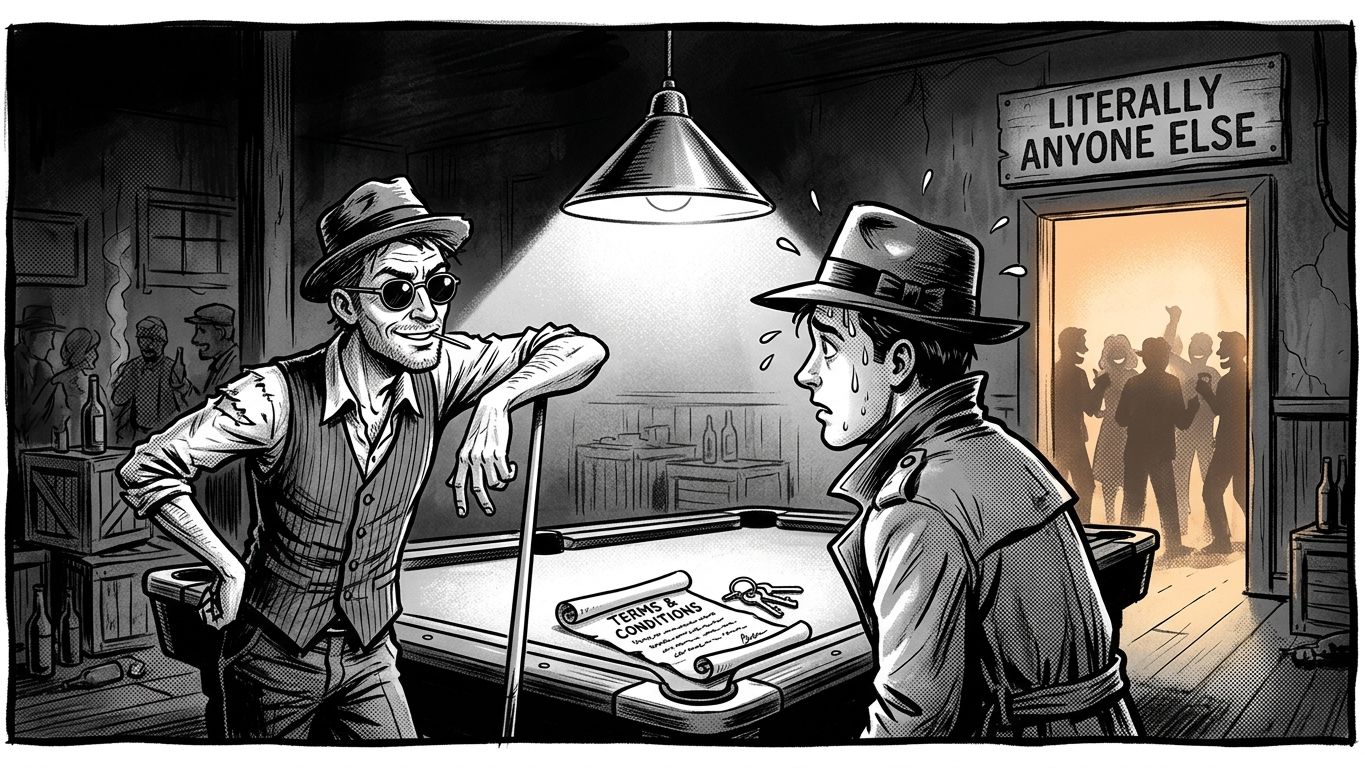
You find someone. They seem nice. They pick up a cue, look at the table, look at you, and say "loser pays?" before the balls are even racked.
That is two words, and they change everything. What was a casual game is now a small financial negotiation with somebody who has clearly done this before. You say yes because saying no feels like admitting something. You then spend the whole rack thinking about the table fee instead of the shot.
Here is the part nobody says out loud: the person proposing it has already decided who the loser is. They are rarely wrong. There are variants, and they get worse. Loser racks is harmless. Loser pays and racks is a hostage situation.
Loser Pays is the single most reliable way to make sure a casual player never comes back. It turns playing someone better than you from a fun challenge into a fun challenge with an invoice.
So we fixed it
The whole problem, from the drought to the invoice, is really a coordination problem. Finding someone is slow, agreeing a time is slower, and the money conversation happens at the worst possible moment, in person, holding a cue.
So Qtally now does it the other way round. Someone hosts a game: the venue, the time, the level, and whether it is a casual knock-about or something more serious. Everyone else can see it and decides whether to join. No back and forth, no "does Thursday work," no seventeen messages to arrange one frame.
Hosting is the important bit. Most matching leaves two strangers to sort out the details between themselves, which is where plans go to die. A hosted game arrives with the details already decided. You are not agreeing to meet someone. You are agreeing to a game that already exists.
The serious option is there for people who want it, and they are welcome to it. The casual option is there so nobody else ends up in their game by accident.
The money is settled before anyone arrives. When the host proposes the game, they choose Host Pays or Split. Loser Pays is not on the list. That was deliberate. Split does exactly what it says. Host Pays is for the person who wants a game badly enough to buy it, which is a far more honest arrangement than pretending you both might lose.
Someone joins, the booking is confirmed, you play. Afterwards you can log the score if you want the record, or leave it, which is also a perfectly valid way to remember a game you lost.
It works anywhere, although for now the venues listed are all in Dubai. It lives at qtally.com/play.
The fix is boring. That is the point. You get a game, the table is sorted, and nobody has to negotiate anything.
Meeting your match
A few rulings for the first game with somebody new.
Arrive on time. Say hello before the break, not after, because introductions made after someone has just cleared the table land differently. Be honest about your level when you pick a game, because the whole system only works if "casual" means casual. Do not coach. Do not apologise after every shot. And let the room do what rooms do, which is mostly to leave you alone.
If it goes well, host the next one yourself.
The point
Pool partners are like good cafés. Once you find one, you keep them. The difference now is that finding one no longer depends on the group chat waking up.
Rotate venues, not people.