
How to Pick a Cue From the Wall Rack (They Are All Bent, Some Are Just Less Bent)
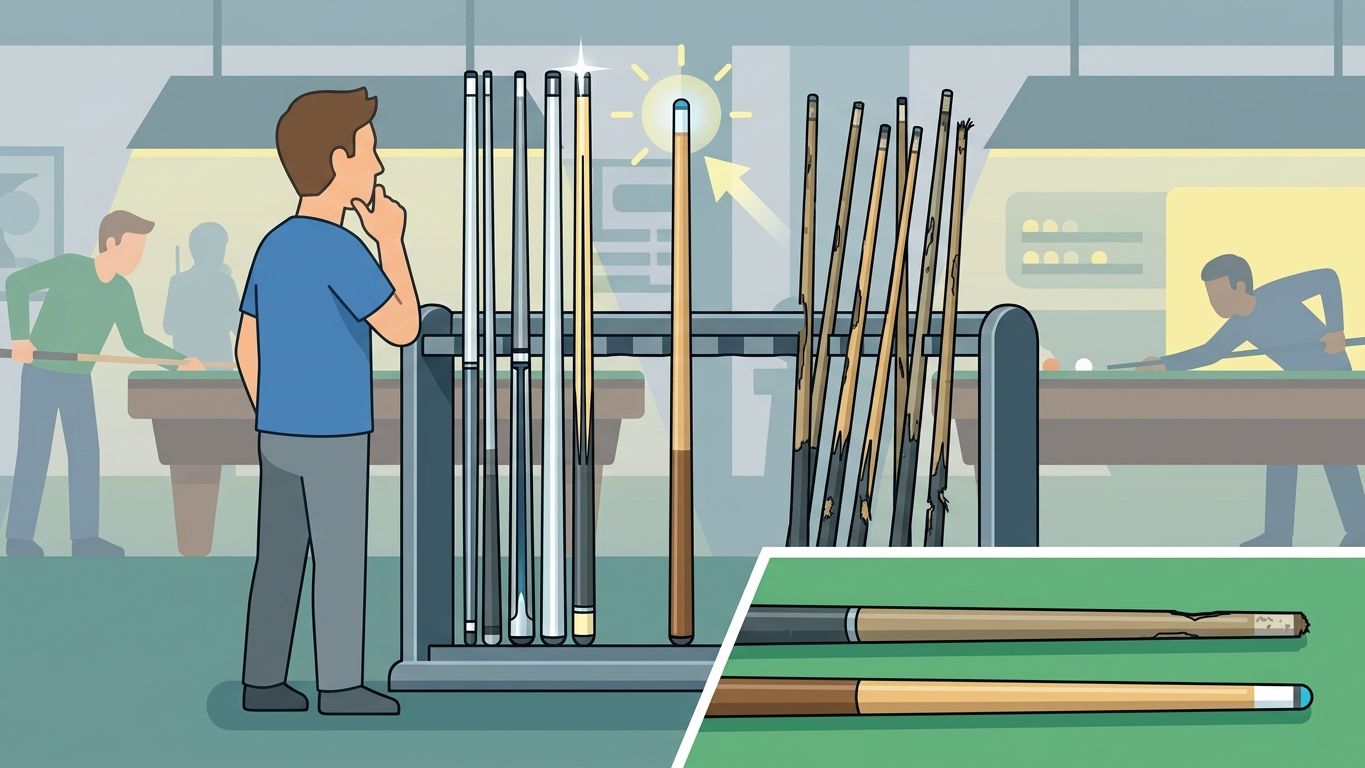
Check the tip, not the shaft. Everything else is theatre.
Four people stand in front of a wall of sticks, silently competing at a skill none of them possess.
This happens at the start of every pool night and nobody has ever written it down. Somebody rolls a cue along the slate because they saw it in a film. Somebody sights down a shaft with one eye shut and learns nothing from it. Somebody takes whichever one is nearest and never thinks about it again.
So, the verdict, before we go further. The house cues run from bad to slightly less bad, and at the rack you are choosing a position on that spectrum, not selecting a weapon. It is the one part of walking into a pool hall that nobody warns you about, mostly because everyone doing it is bluffing.
The ritual, annotated
There are four moves and everybody performs at least two of them.
The roll test. The cue goes on the slate, the performer watches it travel and nods, having no idea what a failed roll is supposed to look like. If it wobbles they put it back and take another one that also wobbles. The test is real. The tester is not.
The one-eye sight down the shaft. Genuinely diagnostic, and genuinely being carried out by somebody who has no intention of acting on the result. They squint. They frown. They say "yeah, that one's fine," and everybody believes them, because the alternative is doing it yourself.
The two-handed heft. A cue is lifted, weighed, passed between palms, and then returned to precisely the position it started in. This communicates nothing to anyone, including the person doing it.
The nod. The nod is the entire point of the exercise. The nod says: I have assessed. The nod is load bearing.
None of this is beginner behaviour, incidentally. The worse somebody is at pool, the more likely they are to just take one. The ritual scales with confidence, not with competence.
The one real rule
Check the tip, not the shaft. Everything else is theatre.
That is the only genuinely useful sentence in this article, so here it is: a tip that is flat, glazed, shiny, or missing outright will slide off the cue ball on anything that is not a dead centre hit, and you will spend the whole evening quietly concluding that you have got worse at pool. You have not got worse at pool. A small piece of leather did that to you and it is not even sorry.
A slightly bent cue with a decent tip beats an immaculate one with a dead tip, every rack, all night.
Look at the tip, take the cue, and go and hold it properly, which matters considerably more than which one you are holding.
Weight, ruled on and dismissed
Everybody claims a weight preference. Nobody has ever identified their preferred cue blind, at any point in the history of the sport.
The spread on a public wall rack is about two ounces, which is roughly the difference between a phone in a case and a phone out of one. You are not detecting that mid conversation while somebody tells you about their flatmate.
Ruling: have a weight preference. Enjoy it. Understand that it is a personality trait rather than an advantage, and carry it with the dignity that implies.
The people at the rack
Four archetypes, one verdict each.
The Deliberator takes ninety seconds, tests six cues, and selects demonstrably the worst one available. They will not be told. They will reference their choice all evening, particularly after misses.
The Case Owner has brought their own. Respect, sincerely, and also: we see you. You have raised the stakes on every shot you take tonight and the rest of us will enjoy that enormously.
The Nearest One takes whatever is closest without breaking stride and then wins. This person is not lucky. They have simply arrived somewhere the rest of the group is still travelling towards.
The Endorser hands a cue to somebody else and says "this one's good," having invented that information on the spot, out of kindness. It is the most frequently told lie in any pool hall and it has never once been challenged.
Swapping mid game: the rules
Swapping is permitted once per evening.
Never immediately after a miss. That is not a swap, that is a confession, and it upgrades a bad shot into a formal statement about your character.
Never while losing. Same principle, worse optics.
Never on the grounds that the cue is cursed. The cursed cue is one of the most heavily used explanations at any table and one of the least plausible ones available, sitting somewhere below the lighting and only just above the chalk.
You may swap freely between racks, for no stated reason, like an adult.
The one concession
A proper hall's rack is noticeably better than the three warped survivors leaning in the corner of a bar, and you can feel the difference inside thirty seconds. This is the single place where the equipment genuinely tells you something, and what it tells you is about the room you are standing in rather than about your game. A Dubai pool hall that looks after its cues is looking after its cloth too, and one that has done neither will let you know within a rack.
So, pick one
The cue is not why you missed. It has never been why you missed. It was not why you missed last week either, and both of us know what was.
Pick one. Chalk it. Stop touching the rack. The person still on their fourth candidate is not going to play better than you tonight, and they will be late for their own break.