
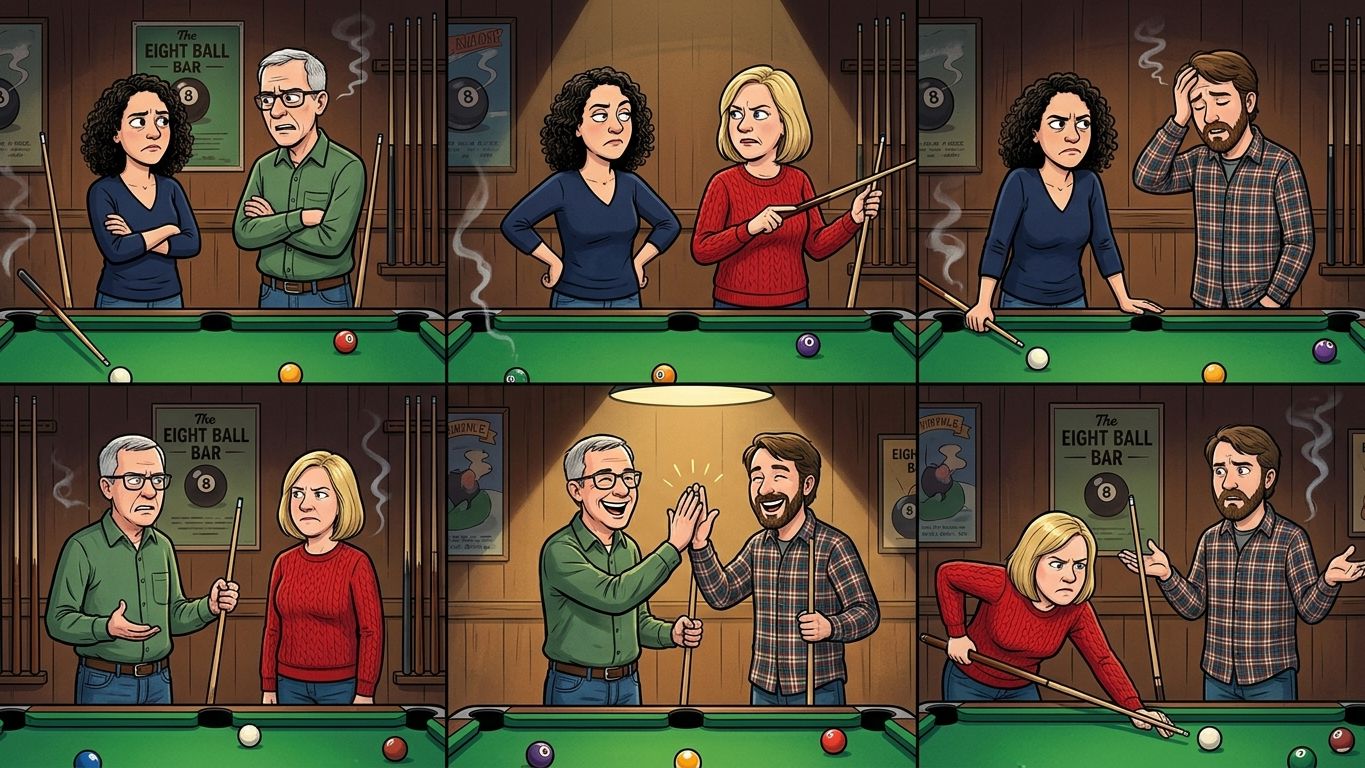
Doubles Pool: The Only Format Where Losing Is Somebody Else's Fault
Four people, one table, and a question nobody treats as a question. Who is with who decides the entire evening.
Four people have arrived at the table. That part is settled, four is the correct number, so we can move on.
Here is the part nobody treats as a decision. Who is with who.
Doubles is the only format in pool where your result is partly somebody else's doing, and that single fact rewrites the night. It is the most forgiving way for a beginner to play, the most humiliating way for a good player to lose, and the only version of the game where you can miss badly and immediately look at another human being.
Team selection is the actual event
Thirty seconds decide the next two hours and everybody treats them as admin.
The Captain picks by ability, resolves the whole thing in four seconds flat, and then cannot understand why the room has gone quiet. They have produced a fair fixture and killed the evening. Both of these are true at once.
The Couple insist on being together. This is not romantic. This is a scheduling problem with feelings attached, and it should be resolved by force before the first break.
The one who says "doesn't matter, whatever" and then visibly minds. We all saw it.
The correct method, stated as law: the two people who most want to win should never be paired. Balance is not about ability. Balance is about intent, and intent is the thing that ruins tables.
One further ruling on this, because it comes up every time. Either the pairs hold all night or they rotate every rack. Pick one at the start and commit. What is not permitted is the reshuffle proposed halfway through by the team that has just lost twice, framed as fairness, arriving with suspicious speed.
The trade
Doubles halves your exposure and doubles your excuses, which is the best trade available in any social sport.
Half the shots means half the opportunities to be visibly terrible. A partner means every terrible shot now arrives with a second plausible cause already attached to it. You did not leave yourself that angle. Somebody did that to you, and everyone watched them do it.
No other format offers this. Take it.
You do not get to choose who takes the hard one
Alternating is not a formality. It is the whole thing.
Here is how it fails, and it never fails loudly. A pair drifts into letting the better player take every shot that matters. Nobody announces it. It happens by three consecutive small courtesies, each one generous, each one making the next one easier. By the fourth rack they have stopped playing doubles and started playing singles with a witness.
Second ruling, related. The whispered strategy conference is fine. The strategy conference that happens over your partner rather than with them is not, and everyone at the table can tell the difference from across the room.
Being carried is fine
Being carried is not embarrassing. It is the ordinary condition of roughly half the people at any table on any given night, and doubles is the format that makes it invisible. If you arrived certain that you would be the one holding everyone up, pairs is the answer, and it was always the answer.
The ruling here is not about the miss. It is about the apology.
Saying sorry after every shot costs the table more than any of the shots did. It converts a normal miss into a small event that three other people now have to attend, and it hands your partner the job of managing your feelings between turns, which is not what they came out for.
Miss. Shrug. Hand over the cue. That is the entire protocol.
And the good partner does the corresponding half of it, which is nothing. No reassurance, no post-mortem, no gentle observation about your bridge hand. They take the cue and play their shot as though the previous forty seconds contained no information at all. This is the highest form of the game.
The partners, itemised
The Silent Sigher says nothing at all and communicates everything. Worse than shouting. Shouting can be answered.
The Over-Encourager says "unlucky" so consistently that around the eleventh time it stops being sympathy and becomes an accusation. Related failure mode, and the same instinct: coaching that nobody asked for, delivered warmly, mid-rack.
The Pointer lines up your shot from the other side of the table, indicating a cue ball that both of you can see perfectly well.
The Apologiser apologises for their own partner, to the opposing team, out loud. Treason. There is no version of this that is kind.
The alternative, for reference
Padel makes you buy kit, find three people with compatible calendars, and book a court at 6am so that you can be quietly disappointed in a partner in direct sunlight. We have been through this.
Doubles pool requires four people and one table. It delivers the identical emotional experience indoors, at a civilised hour, at a fraction of the cost, and nobody has to set an alarm for it.
The concession, because there should be one: singles is a better test of skill. Nobody has ever cared about that on a Thursday.
The point
The best thing about doubles is that half of what goes wrong is genuinely not your fault.
The other half you can usually present as ambiguous.